Tag Archives: Resilience

Resilience

Developing a SMARTER Mindset to increase Resilience, Emotional Intelligence – Part 1

Cynthia Kivland

Cynthia Kivland

Cynthia Kivland, author of Smart2Smarter: How Emotional and Social Connections Bring Humanity into the Workplace: Seven Skills Every Smart Person Needs, reviewed research-based models that suggest ways to increase resilient attitudes and behaviors.

Her “Smart to SMARTER” model is based on interviews with “smart and competent” people in a variety of fields.
Kivland developed a mnemonic device highlight important elements of Emotionally Intelligent or “Emotionally Smart” people:

S – Self – Optimize strengths via self-efficacy
M – Mastery of emotions
A – Attraction – Positive energy, optimism, confidence to attract the best to self, others
R – Resilience – Adapt, reinvent oneself to overcome setbacks
T – Tolerance of emotional experience, changing circumstances, diverse people and beliefs
E – Evolve – Innovate, improve new ways to manage emotions, reactions, behaviors
R – Reciprocity – Lead, be lead; teach, be taught, give, receive

She noted that positive psychology research demonstrated that positive emotions help people endure and grow from life’s changes and adversities.

To help cultivate positive emotions, she suggests three practices:
• Emotional engagement
Schedule fun, enjoyable experiences and opportunities for positive emotions
• Emotional responsiveness
Be present, attentive, and engaged during pleasant moments
• Emotional savoring
“Evolve” by intentionally enjoying positive moments and emotions of joy, contentment, satisfaction, and carrying positive memories into future situations

Salvatore Maddi

“Mindsets” consist of attitudes that can facilitate or impede executing these three recommendations, based on early workplace research by Salvatore Maddi, who studied people affected by organizational change.

He distilled effective coping skills he observed among affected employees as three “Emotional Hardiness” Mindsets:

Commitment vs Alienation – Active involvement with people, life events
Control vs. Powerlessness – Persistence in trying to improve life situations
Challenge vs Threat – Viewing change as an opportunity to learn, adapt, and craft a fulfilling life

In addition, Maddi found that these employees demonstrated two Emotional Resilience Skills:
• Community vs. Isolation – Engaging with others to mobilize social support, feedback
• Proactive Coping (Thriving) vs Reactive Coping (Surviving) – View adversity in context to deepen awareness

Kivland’s Resilience tools

See Part 2 of this post

-*What practices and “mindsets” help you cultivate “emotional hardiness” in your work activities?

LinkedIn Open Group Mindful Leadership
Twitter: @kathrynwelds
Google+
Facebook Notes:
Blog: – Kathryn Welds | Curated Research and Commentary

©Kathryn Welds

Career Resilience in Managing Job Loss, Unexpected Changes

Mary Lynn Pulley

Mary Lynn Pulley

Mary Lynn Pulley, a Center for Creative Leadership adjunct faculty member and author of Losing Your Job – Reclaiming Your Soul: Stories of Resilience, Renewal, and Hope, shares practical recommendations to respond to change or hardship:

Resilience enables people to recover from adversity and is characterized by some of the same attributes as Emotional Intelligence:

• Flexibility
• Durability
• Optimism
• Openness to learning.

The flipside of resilience is burnout, fatigue, malaise, depression, defensiveness and cynicism.

Pulley asserts that resilience can be developed by modifying thoughts to broaden personal outlook and adapt to change.
The second step is modifying actions based on modified attitudes, beliefs, and concepts.

She suggests developing resilience by:

Embracing continuous learning
• Learn and apply new skills to more adapt more quickly during changes
Finding purpose
• Develop a “personal why” to provide meaning and context to work
• Take responsibility to direct your personal and career development
• Separate who your self-definition and core identity from your work tasks and job title. “Who you are is not just what you do.”

Cultivating relationships
• Maintain personal and professional relationships for support and feedback, to develop perspective, achieve goals, deal with hardships

Questioning and modifying self-definition and career
• Reassess awareness of personal skills, talents and interests, and personal narrative
• Consider new work opportunities to align with current skills
• Practice new behavioral competencies to align with current situational requirements

Re-thinking money
• Live within your means to remain flexible during unexpected change

Keeping a journal
• The Center for Creative Leadership suggests that writing in “learning journals” or “reflection journals” enables reflection, self-awareness, learning, adaptability, and insight.

Three recommended journal sections include:
1. Event or experience
Describe the occurrence in factual, objective, quantifiable terms:
Who? What? When? Where? How? Why?

2. Reaction
Describe your reaction to the event in factual, objective, quantifiable terms. What did you want to do in response to the event?
What did you actually do?
What were your thoughts?
What were your feelings?

3. Lessons
What did you learn from the event and from your reaction to it?
What did the event suggest as a development area?
What common reaction patterns occur in similar situations?
What different reactions patterns have occurred in the past?
What do these different reactions suggest about progress in developing resilience?

The Center for Creative Leadership suggests that learning comes “reflecting on the doing,” and not just on the “doing” of specific actions.

-*Which of Pulley’s recommendations seem most applicable and feasible to rebound from unbidden changes, like job loss?

LinkedIn Open Group Brazen Careerist
Twitter: @kathrynwelds
Google+:
Facebook Notes:
Blog: – Kathryn Welds | Curated Research and Commentary

©Kathryn Welds

Reduce Stress by Resetting Expectations about Life’s Five “Givens”

David Richo

David Richo

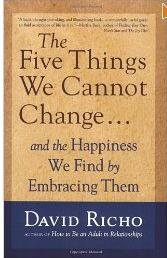
David Richo integrates Eastern and Western philosophies in his book, The Five Things We Cannot Change: And the Happiness We Find by Embracing Them,  to conclude that human life operates in the context of five unavoidable “givens”:

• Everything changes and ends
• Things do not always go as planned
• Life is not always fair
• Pain is a part of life
• People are not always loving and loyal

He asserts that people can experience misery, frustration, anxiety and a host of other uncomfortable emotions if they expect life to contradict these five “givens.”

An approach to reducing stress generated by fighting these “givens” is to reset expectations and to practice a “radical acceptance” of these realities.

Abundant social science research demonstrates that dissatisfaction is generated by the gap between expectations and experience.

Individuals have more control over their expectations than their actual experiences, so a stress-reduction tactic is to modify expectations related to life’s five “givens.”

-*How do you deal with life’s “givens” that may not be as you would like?

LinkedIn Open Group – Brazen Careerist:
Twitter @kathrynwelds
Google+
Facebook Notes:
Blog: – Kathryn Welds | Curated Research and Commentary

©Kathryn Welds