Tag Archives: Bias

Three Factors Affecting Women in Corporate Leadership

Sara King

The Center for Creative Leadership’s Sara King and Northwestern University professor Alice Eagly examine the obstacles, pressures and trade-offs women face at every stage of their careers to analyze the reason that only three percent of Fortune 500 leaders are women.

Alice Eagly

King’s and Eagly’s research identified three factors affecting women in corporate leadership roles:

•    “Walking the narrow band” of acceptable behaviors: tough and demanding to be credible and effective but “easy to be with”; demonstrating the desire to succeed but not appearing “too” ambitious

•    “Owned by the job”, with the expectation of availability and productivity 24/7

•    “Traversing the Balance Beam” of conflicting role demands and limited time to fulfill them

They provide familiar suggestions:
•    Seek out mentors and advocates

•    Take risks, accept challenges to demonstrate adaptability, versatility.
Communicate willingness to change jobs and take on special projects to gain experience.
Learn from research findings that women are not viewed as promotable if they stay in one area of expertise or have a narrow functional role.

•    Communicate decisions, demand results, even if unpopular or requiring change management and persuasion

•    Project confident. Projecting an effective leadership image requires confidence. Don’t undermine good results with a weak or too modest self-image

Through the Labyrinth: The Truth About How Women Become Leaders.
Alice H. Eagly  Linda L. Carli, 2007 Harvard Business School Press.
The Center for Creative Leadership showcased related research that identified five themes among high-achieving women: agency, authenticity, connection, self-clarity and wholeness.

Agency, taking control of one’s career:
•    Analyze career steps
•    Set realistic, specific goals and develop a plan for achieving them
•    Ask for challenges outside your current functional orientation
•    Seek recognition
•    Ask for what you deserve

Authenticity, being genuine, being yourself by developing self-awareness to clarify   values, preferences, skills, acceptable trade-offs and acceptable sacrifices.

Connection, by taking time for people, to build personal and professional relationships, networking, finding a mentor, establishing a personal “board of directors” to provide support and feedback.

Self-clarity from seeking feedback and reflecting on one’s values, motivations, behaviors, strengths, weaknesses, impact on others.
This is a continuing process of evaluating changes in your needs, motivations, goals, values, while observing patterns, and being open to possibilities.

Wholeness from seeking roles beyond work or to unite different life roles, by prioritizing commitments and saying “no” to low-priority roles or obligations.

-*What solutions have you seen most effective in navigating the challenges facing women seeking leadership roles?

LinkedIn Open Group Catalyst
Twitter: @kathrynwelds
Google+
Facebook Notes:
Blog: – Kathryn Welds | Curated Research and Commentary

©Kathryn Welds

Overcoming Decision Bias: Allure of “Availability Heuristic”, “Primacy Effect”

Dana Carney

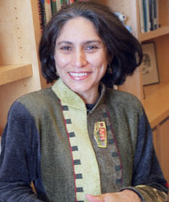
Dana Carney of Berkeley’s Haas School of Business and Mahzarin Banaji of Harvard University investigated whether people prefer the first option they receive in their paper, “First is Best”.

Olympics gymnastic competitors are aware of this phenomenon, and typically prefer to perform first, to “set the standard” against which other competitors must excel.
Volunteers in one experience were shown pictures of two violent criminals and then asked which one deserved parole.
Mahzarin Banaji

Mahzarin Banaji

Most favored the first mug shot they viewed, no matter the order of viewing.
Similarly, 68% of respondents at a railway station in Boston preferred the first stick of gum they were offered, and volunteers preferred to buy a car from the first salesperson they met.
This is one reason that the first advertisement break on television costs 10-15% more than the second, according to Jonathan Allan, sales director at British broadcaster Channel 4.

Carney and Banaji concluded that people “consistently” the first choice if they have time limits or are distracted, and that this primacy effect is even more important online, because few people scroll through dozens of pages of search results.
Google page rankings, and dating sites such as Badoo, are aware of this trend, and offer enhancements to position results in a more eye-catching location.

Awareness of the human cognitive short-cuts that bias decision making can mitigate their effects.

-*What decision short-cuts do you use?
-*When have you seen these heuristics lead to decision bias?

Blindspot: Hidden Biases of Good People, Mahzarin R. Banaji, Anthony G. Greenwald

LinkedIn Open Group: Mindful Leadership
Twitter: @kathrynwelds
Google+:
Facebook Notes:
Blog: – Kathryn Welds | Curated Research and Commentary

©Kathryn Welds

Human Decision Biases Modeled with Automatons

Yuval Salant

Yuval Salant

Yuval Salant of Northwestern University’s Kellogg School of Management, notes that research by psychologists and behavioral economists established that humans exhibit predictable biases in making decisions.

He created an algorithm-based mathematical model of how a machine would make choices with limited information.
Some automatons make the same type of predictable errors as humans, including the “primacy” effect (choosing one of the first items on a list) or the “recency” effect (selecting the last item on a list).

One of Salant’s automatons is based the decision-making strategy known as “satisficing”, or establishing in advance the criteria an option must fulfill to be selected.
This type of decision-making may pertain in selecting a meal, a residence, vehicle, vacation, or mate.

These three decision-making tendencies might be considered short-cuts, or heuristics, to avoid the exhaustive task of thoroughly analyzing every possible option.

As a result, computer scientists surmise that this type of “rational” (thorough) decision making does not scale for large problems, due to limitations of processing power and memory.
The same may be true for human decision-making in light of limitations to “working memory” (correlated with IQ), not to mention inevitable time constraints.

Salant’s most human-like automaton is a “history-dependent satisficer,” which may remember previously-considered and may modify its decision criteria based on available options.

He pointed to examples that support the decision biases he identified: people are more likely to vote for candidates who appear first on a ballot, to order one of the first items on a menu, to click on options at the top of a computer screen (such as an airline or hotel option).

-*What decision biases do you experience?
-*How do you neutralize your potential decision biases?

LinkedIn Open Group – Social Media Marketing
Twitter: @kathrynwelds
Google+
Facebook Notes:
Blog: – Kathryn Welds | Curated Research and Commentary

©Kathryn Welds

Detect and Mitigate Decision Biases

Sydney Finkelstein

Sydney Finkelstein

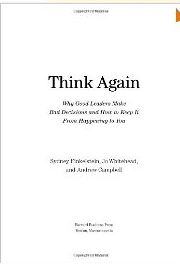
Sydney Finkelstein, Jo Whitehead and Andrew Campbell of Dartmouth’s Tuck Business School, posit that leaders make decisions largely through unconscious neural processes in their book and Harvard Business Review article, Think Again: Why Good Leaders Make Bad Decisions and How to Keep it from Happening to You

• Pattern recognition
• Emotional tagging.

Although these processes are usually effective “heuristics” that enable quick and often prudent decisions, pattern recognition and emotional tagging can be distorted by biases including:

• Self-interest
• Emotional attachments to a position
• Misleading memories derived from inaccurate generalizations from dissimilar previous situations

The authors articulate common-sense recommendations to detect and mitigate “red flags” to decisional bias, echoing conclusions from much-earlier research on “GroupThink” more than four decades ago:

• Enlist the perspective of an independent person to identify which decision makers are likely to be affected by self-interest, emotional attachments, or misleading memories

• Develop safeguards and oversight mechanisms in organizational governance processes

• Alert decision-makers to possible sources of bias

• Build in opportunities to analyze, “spar”, challenge, decisions

-*What approaches do you use to detect and neutralize your potential biases in decision-making?

LinkedIn Open Group – Mindful Leadership:
Twitter: @kathrynwelds
Google+
Facebook Notes:

©Kathryn Welds