Tag Archives: Amos Tversky

Nothing to Lose: Effective Negotiating Even When “Powerless”

Michael Schaerer

Most negotiators prefer to have a “fall back position.”
However INSEAD’s Michael Schaerer and Roderick Swaab with Adam Galinsky of Columbia found that having no alternatives and less power than co-negotiators can improve outcomes.

A weak alternative can establish an unfavourably modestanchor point,according to Hebrew University’s late Amos Tversky and Daniel Kahneman of Princeton.

Adam Galinsky
Adam Galinsky

These “lowball” first offers usually undermine a negotiator’s final outcome.

Professional athletes and their agents provided examples of negotiating better deals when they had no “back up” offers and “nothing to lose.”  They set more ambitious anchor points, and often negotiate a more favourable settlement.

Amos Tversky
Amos Tversky

Schaerer and team asked a hundred people whether they would prefer to negotiate a job offer with a weak alternate offer or without any alternative.
More than 90 percent of participants preferred an unattractive alternative offer, confirming that any alternative is usually seen as better than no alternative.

Schaerer asked volunteers to sell previously-owned music when they had:

  • No offers (no alternative),
  • One offer at USD $2 (weak alternative),
  • A bid at USD $8 (strong alternative).
Roderick Swaab
Roderick Swaab

Volunteers in each group proposed a first offer, and rated the degree of power they felt.
People with the “strong” alternative felt most powerful and those with no alternative felt least powerful.

Volunteers with a weak alternative felt more powerful than those with no alternative, but they made lower first offers.
This indicated that they had less confidence than participants with no alternative.

Conclusion: Having any alternative can help people feel powerful but can undermine negotiation performance.

Schaerer’s team asked a volunteer to “sell” a coffee mug to a potential “buyer,” who was a confederate of the researchers.

The volunteer “seller” received a phone call from “another buyer,” who was a confederate of the researchers, before the volunteer seller met the original potential buyer.
When half the “sellers” met the original purchase prospect, the “buyer” made a low offer.
The “buyer” declined to bid for the other half of “sellers.”

Daniel Kahneman
Daniel Kahneman

Sellers without an alternative offer said they felt less powerful, but made higher first offers and received significantly higher sales prices than negotiators with an unattractive alternative.

In another situation, half of the “sellers” concentrated on available alternatives (none, weak, or strong) and the remaining negotiators focused on the target price.

Volunteers with unappealing alternatives negotiated worse deals than those with no options when they focused on alternatives.
“Sellers” avoided this pitfall by concentrating on the target price.
Conclusion:  Focus on the goal when alternatives are weak.

Negotiators with non-existent or unappealing alternatives can set audacious goals and make an ambitious opening offer because they have “nothing to lose.”
This strategy usually renders better results for the disadvantaged negotiator.

  • How do you overcome lowball anchoring when you have few negotiation alternatives?

RELATED POSTS:

©Kathryn Welds

Thinking in a Second Languages Reduces Decision Bias 

Boaz Keysar

Boaz Keysar

People who can think in a foreign language are more able to rationally analyze risk compared with evaluating risk in their native language, found University of Chicago’s Boaz Keysar, Sayuri L. Hayakawa, and Sun Gyu An.

Sayuri Hayakawa

Sayuri Hayakawa

When volunteers analyzed risks presented in their native language, they were risk-averse when considering potential gains and more risk- tolerant when considering possible losses.
However, they were did not show this risk assessment bias when they considered the same risks vs rewards in a foreign language.
Using a foreign language reduced loss aversion and increased acceptance of hypothetical and real bets with positive expected values.

Micheline Favreau

Micheline Favreau

This effect could occur because foreign languages are typically processed more slowly than in a native tongue, leading to more deliberate cognitive processing, argued Concordia University’s Micheline Favreau and Norman Segalowitz.

Norman Segalowitz

Norman Segalowitz

Foreign language processing generally requires greater cognition-intensive systematic, analytical effort, leading to increased emotional and cognitive distance than in a native tongue, suggested Princeton’s Daniel Kahneman in his distinction between Thinking Fast and Slow.

Stefano Puntoni

Stefano Puntoni

Even when people fully understand language nuances including colloquialisms, impolite words, terms of endearment and reproach, they react less emotionally in a foreign language, according to self-report and electrodermal measurements, found Erasmus University’s Stefano Puntoni, Bart de Langhe of University of Colorado, and Cornell’s Stijn M.J. van Osselaer.
As a result, more than half the participants preferred the riskier option presented in a foreign language instead of the native tongue.

Richard Thaler

Richard Thaler

This finding confirmed participants’ tendency toward myopic risk aversion, or greater sensitivity to losses when thinking and acting in their native languagedescribed by University of Chicago’s Richard Thaler, Amos Tversky of Stanford, Princeton’s Kahneman, and Alan Schwartz of University of Illinois.

Amos Tversky

Amos Tversky

Among more than 140 native Korean speakers and more than 100 English speakers in Paris, Keysar’s team confirmed the same pattern of enhanced deliberation and reduced framing effects in a foreign language in hypothetical low-loss, high-gain bets.
Just 57 percent of Korean-speaking participants accepted bets offered in Korean, contrasted with 67 percent when offered in English, suggesting heightened deliberation in a second language.

Daniel Kahneman

Daniel Kahneman

Likewise, more than 50 English-speaking volunteers who spoke Spanish as a second language received $15 in $1 bills, which could be kept or bet on a coin toss.
For every lost toss, participants lost $1.
However, if they won, they kept the $1 and earned another $1.50, a significant return on the chance bet.
When conducted in participants’ native English language, 54% accepted bets, whereas when presented in Spanish, 71% agreed to bet.

Alan Schwartz

Alan Schwartz

“They take more bets in a foreign language because they…are less affected by the typically exaggerated aversion to losses … People who routinely make decisions in a foreign language rather than their native tongue might be less biased in their savings, investment, and retirement decisions, as a result of reduced myopic loss aversion” wrote Keysar and colleagues.

-*How do you reduce “myopic risk aversion” in your native language?

Follow-share-like http://www.kathrynwelds.com and @kathrynwelds

Related Posts:

Twitter: @kathrynwelds
Google+
LinkedIn Groups Psychology in Human Resources (Organisational Psychology)
Facebook

Blog: – Kathryn Welds | Curated Research and Commentary

©Kathryn Welds

Perseverance Increases Skill Increases Luck: “The Harder I Work, The Luckier I Get”

Samuel Goldwyn

Samuel Goldwyn

Thomas Jefferson

Thomas Jefferson

Samuel Goldwyn recast Thomas Jefferson’s earlier observation: “I am a great believer in luck, and I find the harder I work, the more I have of it.”

Michael Mauboussin, of Columbia University, and previously Chief Investment Strategist at Legg Mason Capital Management Inc. investigated this relationship between effort and luck in his book, The Success Equation.The Success Equation

Michael Mauboussin

Michael Mauboussin

Mauboussin, an innovator in behavioral finance, adopted Harvard biologist Stephen Jay Gould’s “paradox of skill” to analyze the interaction of effort, skills, and luck, and best strategies to optimize outcomes in investing, sports, and career performance.

Stephen Jay Gould

Stephen Jay Gould

He posits that as skill improves in activities where outcomes are affected by skill and luck, the standard deviation of skills narrows.
In this case, luck becomes more important in determining outcomes:

Whenever you see an outlier in sports, it is always a combination of really good skill and really good luck… (Often) they are about one and a half or two standard deviations away from the average…not all skilled players have (winning) streaks, but all (winning) streaks are held by skillful players.”

For example, as investors become more sophisticated and have access to advanced computational tools, as athletes benefit from targeted training and development regimens, and as students are groomed for admission to top universities, differences among these skilled performers decreases.
Chance influences can determine outcomes.

Mauboussin says that luck has several elements:

  • Affects an individual or organization,
  • May be evaluated as “good” or “bad”
  • Another outcome could have occurred
  • The outcome is uncontrollable, but is comprised of several elements

To increase luck, he advises assessing each contender’s strength in the situation and finding “…something completely different to get you on the right side of the tail of the skill distribution,” such as employing an unusual or unexpected tactic.

The stronger player has positive asymmetric resources, so the effective strategy is to simplify the game.
In contrast the underdog should seek to complicate the game, such as through disruptive innovation, a flank strategy or a guerilla tactic.

Because most people have a bias toward optimism and overestimate personal capabilities, it may be difficult to assess oneself as an “underdog” in a performance situation.

Daniel Kahneman

Daniel Kahneman

Nobel Prize winner Daniel Kahneman and Amos Tversky explained that individuals who adopt an inside view gather substantial information, combine it with their own inputs, then project into the future without considering “distributional information” about a wide variety of previous instances.
This approach risks developing an idiosyncratic, overconfident perspective by underestimating costs, completion times, and risks of planned actions, while overestimating benefits.

Amos Tversky

Amos Tversky

In contrast, people who adopt the outside view consider the problem as an instance of a larger reference class and consider the entire distribution of outcomes when this type of situation occurred previously.
This approach can reduce overconfidence.
However, this approach could discourage entrepreneurs, who will realize that a small percentage actually succeeds.

In addition, besides the bias toward overconfidence, people tend to “under-sample” instances of failure when a previously successful approach is applied in a new situation and doesn’t succeed.

Nate Silver

Nate Silver

Sabermetricians like Nate Silver, posit that worthwhile statistics provide:

  • Persistence or correlation from one period to the next, a strong indicator of high skill
  • Predictive value or high correlation with the target objective

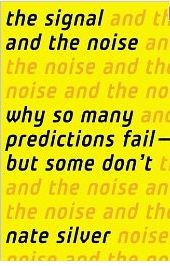
Nate Silver-The Signal and The NoiseThe Oakland As baseball team uncovered these principles in determining that  a superior measure of athletic performance in this sport is on-base percentage rather than the traditional measure, batting average.

In this case, on-base percentage has a higher correlation from one season to the next and a higher correlation with run production than batting average, fulfilling both criteria.

Daniel Kahneman also suggested that skill, expertise, and intuition render more uniform results in a predictable environment.

Thinking Fast and SlowHowever, many organizational environments are unstable and non-linear, rendering experts less accurate because they cannot employ an effective predictive model.

Collective judgments through “the wisdom of crowds” may mitigate the challenges of unstable contexts because they provide more data points.

Mauboussin advocated considering the continuum of stability vs instability in which the issue is situated to determine strategy and to beware of applying simple heuristics that are vulnerable to bias, and social or situational influences.

He suggested the guideline “think twice” to prepare, detect and correct for common mental traps, including:

  • The Inside-only View
  • Tunnel Vision
  • Oversimplification
  • Situational Power
  • Overvaluing Expert Knowledge

-*How do you optimize your performance when chance elements can affect your outcomes?

Related Posts

©Kathryn Welds