

Michael J. Reilly
People often infer others’ personality attributes from visual cues, found Georgetown University Hospital’s Michael J. Reilly, Jaclyn A. Tomsic and Steven P. Davison, collaborating with Stephen J. Fernandez of MedStar Health Research Institute.
This facial profiling is cognitive shortcut that can lead to biased impressions and fewer professional and social opportunities for those unfavorably judged.

Jaclyn A. Tomsic
These researchers asked volunteers to evaluate photographs of 30 women shown with neutral facial expressions.
Each rater judged 10 images, including five (5) photographs before the person had plastic surgery procedures and five (5) images following surgical procedures:
- Chin implant,
- Eyebrow-lift,
- Lower blepharoplasty (lower eye lift),
- Upper blepharoplasty (upper eye lift),
- Neck-lift,
- Rhytidectomy (face-lift).

Raters were not informed that some people in the photos had plastic surgery procedures.
Evaluators assessed each photograph on a 7-point scale for perceived:
- Aggressiveness,
- Extroversion,
- Likeability,
- Risk-seeking,
- Social skills,
- Trustworthiness,
- Attractiveness.
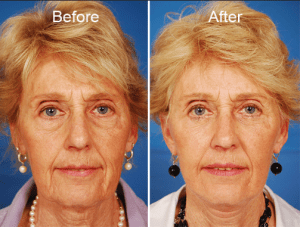 Raters assigned higher scores for likeability, social skills, and attractiveness to the images following plastic surgery compared with pre-surgery image ratings.
The researchers concluded that the eyes signal attractiveness and trustworthiness.
They noted that people who had lower eyelid surgery were rated significantly more attractive and trustworthy.
The team concluded that corner of the mouth indicates happy and surprised expressions and personality traits like extroversion.
Likewise, they reported that an upturned mouth and fullness in the cheeks can make a person look more intelligent and socially skilled.
In sum, they found that people who had a facelift procedure were rated significantly more likeable and socially skilled postoperatively.”
Volunteers in a different study attributed positive and negative personality traits to neutral faces when they perceived a similarity to standard positive and negative emotional expressions, reported Princeton’s Christopher P. Said and Alexander Todorov with Nicu Sebe of University of Trento.

Christopher P. Said
This perceptual bias was demonstrated when volunteers attributed positive personality characteristics to faces with neutral expressions when some aspect of the face resembled typical facial expressions of happiness.
Similarly, neutral faces seen attributed negative personality characteristics when they had some similarities to displays of disgust and fear.
These trait inferences resulted from overgeneralization in emotion recognition systems.

Nicu Sebe
This error can lead to misattributed personality traits and biased impressions.
However, these inaccurate and biased judgments can become more favourable after plastic surgery.
-*To what extent do people’s personality traits seems different following plastic surgery?
-*How often are people treated differently following plastic surgery?
–*What are ways to avoid confusing emotional expressions with personality traits?
Related Posts:
- How Accurate are Personality Judgments Based on Physical Appearance?
- How Much Does Appearance Matter?
- Attractiveness Bias in Groups
- “Self-Packaging” as Personal Brand: Implicit Requirements for Personal Appearance?
- Executive Presence: “Gravitas”, Communication…and Appearance?
©Kathryn Welds
 Kathryn Welds, PhD | Curated Research + Commentary
Hi Kathryn,
OMG – this is a stunner.
On a separate note, the post I did for you on Women vs. Men’s Time Management Skills… are you still planning to use it? Or did I just miss it completely?
Thanks
Francis
I’m not surprised by this study. However, it is interesting to learn just how deep our ‘first impressions’ based on physical characteristics really go. Rather disconcerting.
You are so right, Sharna, that the biasing impact of physical characteristics can be disconcerting.
Recognizing the power – and often inaccuracy – of first impressions enables people to increase awareness of potential misperceptions and take corrective steps.
Heidi Grant Halvorson of Columbia suggests strategies to repair mistaken first impressions in No One Understands You and What to Do About It – http://www.amazon.com/One-Understands-You-What-About/dp/1625274122/ref=asap_bc?ie=UTF8
Francis Wade wrote:
OMG – this is a stunner.
On a separate note, the post I did for you on Women vs. Men’s Time Management Skills… are you still planning to use it? Or did I just miss it completely?
Thanks
Francis
Kathryn Welds replied:
Thanks for your note, Francis, and your inspiration for Women, Men, and Time: Differences in “Managing” a Limited Resource, published 29 July 2015 @ https://kathrynwelds.com/2015/07/29/women-men-and-time-differences-in-managing-a-limited-resource/
Gary W. Kelly wrote:
This fits with the previous posts on perceived attractiveness. A part of why this sample may have been rated more highly after plastic surgery may have been due to increased confidence, and an improved self image. People are literally more likely to “face the world”, as opposed to prior behaviors of hiding themselves, minimizing interactions, etc.
It makes the case that “cosmetic” surgery is int entirely cosmetic at all. It can be life changing and address more issues than aesthetic ones. Hopefully, these findings should encourage everyone to make life style adjustments that maintain an optimal physical appearance, as it is best to avoid having to have plastic surgery to correct features that may have changed more due to lifestyle than any medical condition.
Kathryn Welds replied:
Thanks, Gary, for the reminder that optimal physical health based on a healthy lifestyle is even more important than physical appearance.
For more on the biasing impact of attractive physical appearance, see:
* The Attractiveness Bias: “Cheerleader Effect”, Positive Attributions, and “Distinctive Accuracy” – https://kathrynwelds.com/2013/12/18/the-attractiveness-bias-cheerleader-effect-positive-attributions-and-distinctive-accuracy/
* Accurate are Personality Judgments Based on Physical Appearance? – https://kathrynwelds.com/2013/11/10/how-accurate-are-personality-judgments-based-on-physical-appearance/
* Much Does Appearance Matter? – https://kathrynwelds.com/2012/11/07/how-much-does-appearance-matter/
* Presence: “Gravitas”, Communication…and Appearance? – https://kathrynwelds.com/2012/11/30/executive-presence-gravitas-communicationand-appearance/
* as Personal Brand: Implicit Requirements for Personal Appearance? – https://kathrynwelds.com/2013/04/04/self-packaging-as-personal-brand-implicit-requirements-for-personal-appearance/
-Attractive Appearance Helps Men Gain Business Funding – But Not Women? – https://kathrynwelds.com/2014/04/06/attractive-appearance-helps-men-gain-business-funding-but-not-women/