
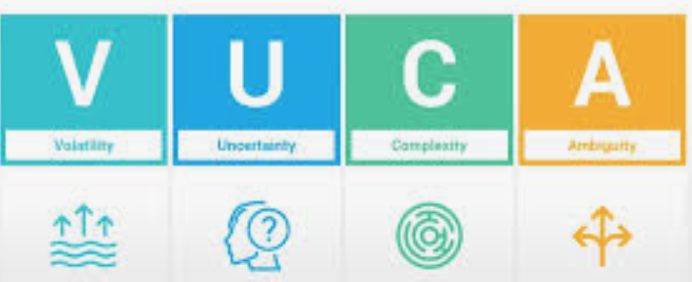
In “VUCA world,” described by the U.S. Army War College as volatile, uncertain, complex, ambiguous environments, career “planning” occurs under rapidly-shifting conditions.
As a result, it is difficult to meaningfully respond to the interview question: “What are your career plans for the next five years?”

Kathleen Eisenhardt
Planning is most suited to relatively certain circumstances when processes and decisions are linear, argued Stanford’s Kathleen Eisenhardt and Behnam Tabrizi.
In contrast, frequently-changing or uncertain conditions require improvisation, frequent testing, and revision.

Behnam Tabrizi
Iterative exploration, rapid prototyping/experimentation, and testing are used in agile software development and are applicable to rapid changes in economic, political, and technology changes that affect career paths.

Alison Maitland
University of London’s Alison Maitland and Peter Thomson offered this perspective in Future Work: How Businesses Can Adapt and Thrive In the New World of Work,
Related views on using flexible “planning” in career development come from Deloitte’s Cathy Benko, Molly Anderson, with Anne Weisberg of Paul, Weiss, Rifkind, Wharton & Garrison LLP in their model of The Corporate Lattice: Achieving High Performance in the Changing World of Work and Mass Career Customization: Aligning the Workplace with Today’s Nontraditional Workforce.
-*When have you found it more useful to “improvise” instead of “plan” your career?
-*What are the benefits of career “improvisation”?
Related Posts:
- Four Career Trajectories: Linear, Expert, Spiral, Transitory
- “Derailing” Executive Personality Measures Predict Leadership Mishaps
- Manage “Triadic Managers” and Navigating Office Politics
- Leadership Qualities that Lead to the Corner Office?
- Training or Mentorship to Build Leadership Skills?
- Leadership “From the Inside Out”
- Executive Presence: “Gravitas”, Communication…and Appearance?
- Leadership Roles Reduce Perceived Stress
©Kathryn Welds
 Kathryn Welds, PhD | Curated Research + Commentary